



Parmigiano Reggiano is a PDO cheese (DOP in Italian). It is made from raw cow's milk, rennet and salt, in a defined area: the provinces of Parma, Reggio Emilia and Modena, the part of the province of Bologna on the left bank of the Reno and the part of the province of Mantua on the right bank of the Po. It is aged for at least 12 months.
After that, the longer it ages, the drier and more crumbly it gets and the stronger it tastes. So the right age depends on what you plan to do with it.
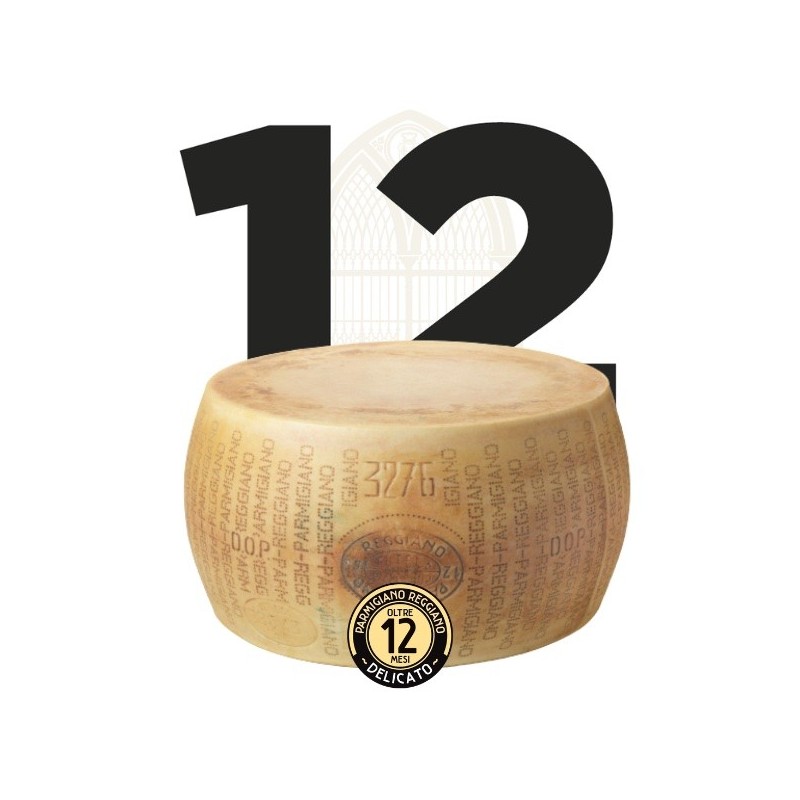
A whole wheel, here aged 12 months.
What ageing changes
12 months
The youngest. The paste is still supple and the taste mild and milky. Cut it into cubes with drinks, or serve it with fresh fruit.
18 months
More balanced. The paste starts to crumble and the aromas build up. A good all-rounder, at the table and in the kitchen.
24 months
The age you meet most often in kitchens. The paste is grainy and crumbly. You will often see small white specks that crunch between the teeth: these are tyrosine crystals, an amino acid, not salt. The flavour is deeper, with notes often described as dried fruit and nuts.
36 months
Dry, very crumbly, with a strong and sometimes sharp taste. Best eaten in small chunks at the end of a meal. Grated, a little goes a long way.
Longer ageing is available on request: just write to us.
Which age for which use
These are guidelines. Every cook has their own habits.
- Grated over pasta: 24 months, or 18 months for a milder taste.
- Risotto: 18 or 24 months, stirred in off the heat with the butter, at the mantecatura stage.
- Carpaccio and salads: shavings of 18 or 24 months, cut with a vegetable peeler just before serving.
- Cheese board: a 24 month on its own, or a 12 and a 36 month side by side so guests can taste the difference. The 36 month goes well with a few drops of traditional balsamic vinegar or a little honey.
- Cubes with aperitifs: 12 or 18 months.
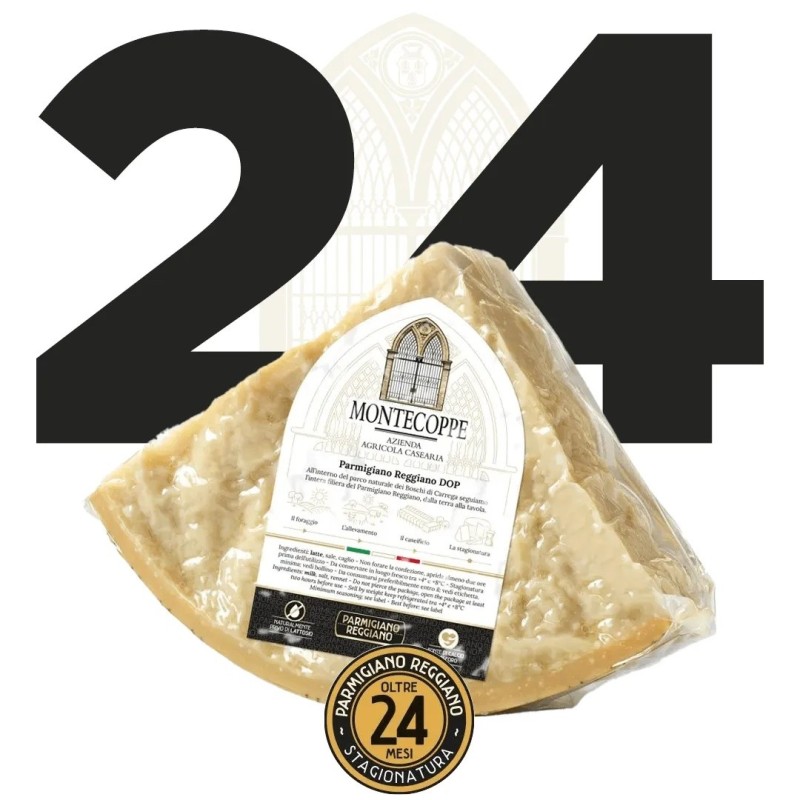
An eighth of a wheel, here aged 24 months.
Which size for which business
Our Parmigiano Reggiano comes in 300 g, 500 g and 1 kg pieces, as an eighth, a quarter or half a wheel, and as a whole wheel, each in all four ages.
- 300 g and 500 g: for home, or for a deli selling pre-packed pieces.
- 1 kg: for a restaurant that grates every day without wanting to hold much stock.
- Eighth and quarter wheel: for restaurants that get through a lot of it, and for delis that cut to order at the counter.
- Half and whole wheel: for cutting in the shop and for businesses working with large volumes. A wheel weighs around 40 kg.
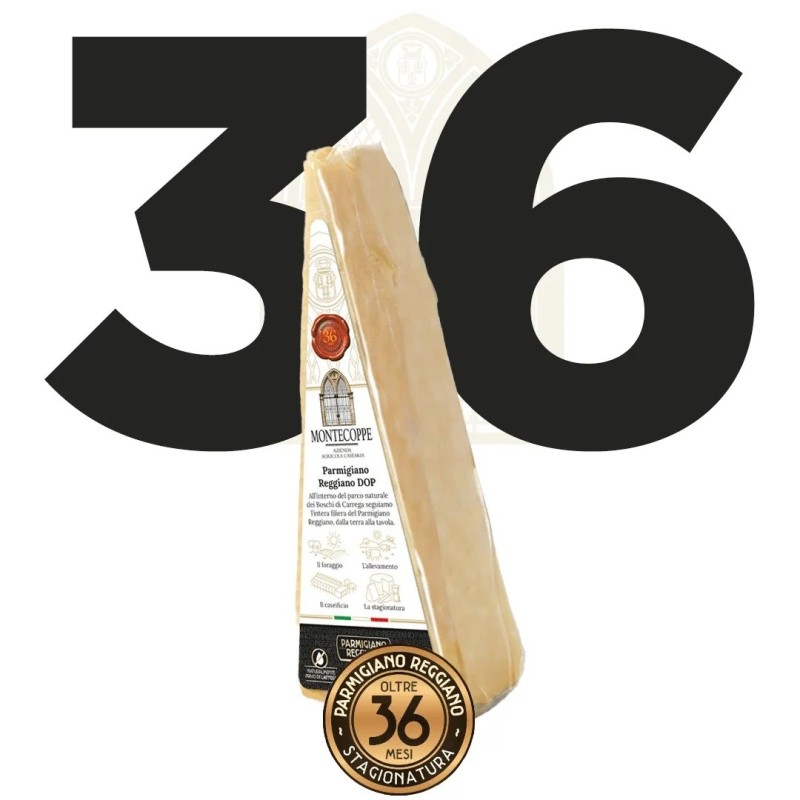
The 300 g piece, here aged 36 months.
Storing and serving
Keep it in the fridge, in the vegetable drawer, well wrapped in cling film or paper so it does not dry out or pick up other smells. A vacuum packed piece keeps until the date on the pack. Once opened, wrap it up again after each use.
For a tasting, take it out of the fridge half an hour to an hour beforehand: straight from the fridge it has less flavour. Break it into chunks with a Parmesan knife, the short almond-shaped blade, rather than slicing it. That way the paste keeps its grain.
Grate it at the last minute. Grated in advance, it soon loses its aroma.
Keep the rind
The rind of Parmigiano Reggiano is not treated with anything: it is edible. Scrape it with a knife, rinse it, then let it simmer in a minestrone, a bean soup or a stock. It softens and adds flavour. Take it out before serving, or cut it into small pieces. In a restaurant kitchen, keep rinds in a closed box in the fridge for the week's soups.
See also: creamery and cheese, burrata, stracciatella and mozzarella, frequently asked questions, business offer.